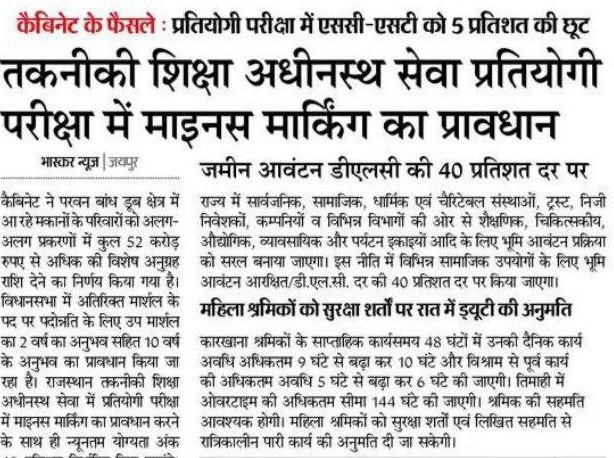
Rajasthan Cabinet Decisions 2025: Major Reforms in Technical Education, SC/ST Relaxation, Land Allotments & Women Empowerment Policies
The Rajasthan government has taken bold steps in its latest cabinet decisions for 2025, introducing landmark reforms across technical education, social welfare, land allotments, and labor laws. These policy changes reflect a progressive vision for inclusive growth, transparent governance, and better public service delivery.
In this article, we will dive deep into these decisions, analyze their implications, and explore how they align with the state’s long-term development goals. Key highlights include:
- Negative marking in technical exams
- 5% relaxation for SC/ST candidates
- Land allotment at 40% DLC rate
- Night shift policy for women
- Compassionate appointments for families of deceased employees
- Token-rate land for disabled and destitute persons
Each of these reforms is supported by a strong rationale, and together, they aim to create a fairer, more inclusive Rajasthan.
📚 Technical Education Reforms: Negative Marking Introduced in Subordinate Service Exams
One of the most talked-about cabinet decisions is the introduction of negative marking in Technical Education Subordinate Service Competitive Exams. This move addresses long-standing concerns about the fairness and credibility of recruitment processes in Rajasthan.
✅ What Is Negative Marking?
Negative marking is a system where marks are deducted for incorrect answers in multiple-choice examinations. In this case, the government has decided that:
“For every two incorrect answers, one correct answer’s mark will be deducted.”
This change promotes accuracy and discourages guesswork, aligning Rajasthan’s competitive exam policies with those of national-level examinations like UPSC and SSC.
🎯 Why It Matters
Implementing negative marking in Rajasthan exams will:
- Improve the quality of selected candidates
- Reduce chances of unfair selection through guessing
- Promote serious preparation among aspirants
- Enhance trust in recruitment systems
This reform directly impacts lakhs of candidates appearing for technical posts and sets a precedent for other examinations across the state.
🧑🎓 SC/ST Relaxation in Competitive Exams: 5% Grace Marks Introduced
Another critical policy decision is the provision of a 5% relaxation in qualifying marks or criteria for SC/ST candidates in Rajasthan competitive exams. This is part of a broader strategy to ensure inclusive hiring policy in Rajasthan, particularly for communities historically marginalized.
👥 Beneficiaries of the Policy
This SC/ST quota in Rajasthan exams applies to all state-level competitive exams under technical and administrative departments. The move is expected to boost:
- Representation of SC/STs in government jobs
- Access to economic upliftment through employment
- Balanced diversity in public institutions
By offering 5% grace in eligibility, the government sends a clear signal toward social equity and constitutional values.
🏞️ Public Welfare Gets a Boost: Land Allotment at 40% DLC Rate
A notable economic and infrastructure reform is the approval of land allotments at 40% of the District Level Committee (DLC) rate for public service organizations.
📌 Who Can Benefit?
This land at 40% DLC rate Rajasthan scheme will benefit:
- Educational institutions (schools, colleges, coaching centers)
- Hospitals and healthcare units
- NGOs and charitable trusts
- Orphanages and old-age homes
- Tourism-related institutions
- Skill development and training centers
💡 Key Impact
By subsidizing land prices, the government is actively encouraging:
- Rapid infrastructure development
- Investments in social services
- Better public access to essential services
- Growth of non-governmental and charitable institutions
This is a huge opportunity for public welfare land distribution in Rajasthan to accelerate across rural and urban areas alike.
👩🏭 Women Empowerment: Night Shift Policy Approved with Strict Guidelines
In a forward-thinking decision, the Rajasthan cabinet approved the night duty policy for women workers across industries under regulated conditions.
📋 Conditions for Night Shifts
To ensure safety and compliance, employers must:
- Provide transportation, food, and sanitary facilities
- Implement safety measures and CCTV surveillance
- Obtain written consent from women employees
- Ensure shifts do not exceed 8 hours/day and 48 hours/week
⚙️ Which Sectors Will Benefit?
- BPOs and ITES companies
- Manufacturing and production units
- Hospitals and 24×7 emergency services
- Retail chains and malls operating at night
The policy aligns with national labor reforms and aims to enhance women’s participation in the formal workforce, promoting both economic independence and gender equality.
🏛️ Welfare for Government Employees’ Families: ₹52 Crore Sanctioned
Recognizing the sacrifices of public servants, the cabinet sanctioned over ₹52 crore in financial assistance for families of deceased government employees.
🤝 Support for Families
The policy ensures:
- Compassionate appointments to eligible dependents
- Financial assistance for pending dues, pensions, or services
- Priority in housing schemes and welfare programs
✅ Conditions
To qualify:
- The deceased must be a government employee in service
- No other dependent should be employed
- The dependent must meet eligibility criteria for the post
This compassionate appointment scheme in Rajasthan brings security and dignity to grieving families, reinforcing the government’s commitment to its workforce.
🧑🦽 Housing for Disabled and Destitute: Residential Plots at ₹25/sq.m.
One of the most heartening decisions was the allotment of residential plots to disabled and destitute individuals at a token price of ₹25 per square meter.
🌍 Who Qualifies?
- Individuals with disabilities certified by a government doctor
- Verified destitute persons with no housing or stable income
🏘️ Benefits
- Access to affordable and secure housing
- Promotion of dignified living for vulnerable citizens
- Opportunity for social integration and independence
This housing scheme for disabled in Rajasthan directly improves quality of life and ensures that no one is left behind in the development journey.
🧾 Summary of Key Cabinet Decisions (2025)
| Policy Area | Reform | Keyword Focus |
|---|---|---|
| Technical Education | Negative Marking | Negative Marking in Technical Exams |
| Social Inclusion | 5% SC/ST Relaxation | SC ST Relaxation in Competitive Exams |
| Land Reforms | 40% DLC Rate Land | Land Allotment at 40% DLC Rate |
| Women Empowerment | Night Duty Approved | Night Duty Policy for Women |
| Welfare | ₹52 Cr for Families | Government Jobs for Deceased Employee Families |
| Housing | ₹25/sq.m for Disabled | Housing Scheme for Disabled in Rajasthan |
📈 Impact on Governance and Society
These Rajasthan cabinet decisions 2025 mark a significant shift toward:
- Transparent and merit-based recruitment
- Equitable representation of SC/ST and marginalized groups
- Infrastructure and social service expansion
- Labor law modernization
- Holistic welfare for citizens and employees
Whether it is the exam marking scheme changes, the inclusive hiring policy, or public welfare land allotment, these reforms signal that Rajasthan is prioritizing people-first governance.
🧠 Expert Opinions and Reactions
👨🏫 Educationists:
“The introduction of negative marking in Rajasthan exams is a much-needed reform. It will encourage students to prepare sincerely and avoid shortcuts.” – Dr. R.K. Sharma, Educational Consultant
👩💼 Social Workers:
“Land at 40% DLC rate for NGOs and charities will go a long way in improving services for the underprivileged.” – Meena Devi, NGO Director
👨🔧 Industry Leaders:
“Allowing night shifts for women workers in Rajasthan under safety protocols opens new avenues for industrial growth and female workforce expansion.” – Rajiv Mehta, Industrialist
📌 Final Thoughts
With these decisions, Rajasthan sets an example for other states in progressive governance, inclusive growth, and empowered citizenship. These reforms don’t just look good on paper—they are practical, measurable, and transformative.
From exam reforms to social housing, from SC/ST inclusion to women’s workforce rights, the state’s new policies truly encapsulate development for all.